Tuesday, October 18, 2016

Still Crazy After All These Years (With Apologies To John Gary, Ray Bolger and P. Simon)

I met Fred for a cup of coffee the other day.

You'd like Fred.

He's a gentle soul. Loves music and plays a little guitar. He's not a bad musician and has written a few songs.

Fred is a little younger then me but he is close enough in age to share memories and song lyrics, something I have always prided myself on.

He is a touch better in that category but he never gets in my face about it.

John Gary. A handsome man and a truly
gifted singer
This particular morning I noticed he was somewhat reserved. Even a little down. Which is somewhat unusual.

Fred is always positive when we get together. Sometimes he will listen to my moaning and groaning (he's a great listener) and, always with a smile, Fred will nudge me, through his patient questions and a comment or two and my shallow problems sort of melt away.But for some reason this morning the poof had gone out of his sail. He looked a little paler then usual and the smile fell flat.

"What up?"  I said, mimicking Andy Dicks' odd encounter with a hypnotist and a chicken on an old episode of "News Radio".

"John Gary." he replied, without a flicker of humor.

I paused.

"John Gary?"  I took another sip of my coffee. "You mean the singer?"

He nodded an affirmation.

John Gary, born John Gary Strader in Watertown NY in 1932, was very talented with amazing breath control  and a range of three and a-half octaves. He could easily go from a robust baritone to a sweet tenor, sometimes within a single song. The world lost an electrifying balladeer when he passed awayin 1995 at the too-early age of 65.

As a former MOR (middle of the road) disc jockey during the 60's I was very aware of Gary and had slipped an LP (with the ubiquitous orange RCA label) on the turntables many a time. He was soothing if anything.
Gary always appeared to me as a pleasant soul who, many critics contend, was the most talented of the popular singers at that time with an intimate style that fit many of the songs written around then.

He rose to stardom in the early to late 60's recording 23 albums for RCA Victor and appearing on numerous television programs (The Tonight Show with Jack Parr, Steve Allen and Johnny Carson) and other venues including numerous community concerts throughout Canada and the US each year. He also had his
own CBS network show as a summer replacement for The Danny Kaye Show.

Fred was looking off at the distance, a pained look creasing a normally happy face.

"What?"  I raised my hands; palms upward from the table top. "So you don't like the guy? Is he a bad person? Did you find something horrible in his past that has recently come to life?"

Fred shook his head,

"No. In fact I think a great performer and a good person." He paused."  Did you ever hear the song, "Once Upon A Time"?

Now it was my turn to crease my pan. He sang a few bars in his pleasant voice.

"Once upon a time, a girl with moonlight in her eyes.
Put her hand in mine and said she loved me so. But that was once upon a time, very long ago,"

Bolger before "All American"
He struggled  to keep his voice level.

"Yeah. I know that tune." And I rummaged through my brain overcrowded with ridiculously too much....never used... trivial information.

Charles Strause and Lee Adams wrote it for a moderately successful  musical produced in the mid-twentieth century,  "All American" starring the ubiquitous scarecrow (He of "The Wizard of Oz" fame) Ray Bolger who talked/sang his way through it as only this wonderfully talented, iconic man can.

It was released as a single by Tony Bennett in 1962 and then later by many others including Frank and Gary.

Fred looked at me with those mournful eyes and tears were actually pooling in the corners

"Its John Gary's version that gets me every time." And he sang a few more lines.

"Once upon a hill we sat beneath a willow tree.
Ray Bolger and Eileen Hurley from All American

Counting all the stars and waiting for the dawn.
But that was once upon a time now the tree is gone."

I was shaking my head now and asked the obvious.

"Who was she Fred?"

He grinned a wry grin, looking like a person caught with his hand in the cookie jar.

"Barbara." At which point I managed to splutter a mouthful of tepid coffee all over the table top and myself.

"Your first wife?"  He nodded.

That was another thing that drew me to Fred. We both had seen the elephant,  marriage wise, twice. The first time was somewhat uncomfortable, to say the least. But the second woman we let into our lives had transformed us into believers that love is lovelier the second time around. The second wife had been the best thing that had ever happened to us.

"Fred, that was over 20 years ago. I thought you said you had left the love you felt and her memory behind and was happier then you ever been?"

He shrugged and paused as the waitress come over and refilled our cups with the steamy black goodness that oils our mental gears.

Fred waited till she left and then leaded forward.

"It's not the physical part of Barbara I miss." He thought a second. "It's the sadness of our divorce." He looked up. "Do you understand?" I thought I did.

"I had hopes and dreams. I thought marriage was the best thing I could rise to,  and I was young enough at the time to think that the world was my oyster. I had children, a house, a life that I thought was perfect." He sipped his coffee. "That song so beautifully interpreted by John Gary flung me into the pits the first time I hear him sing it after Barbara and I broke up."

He shook his head.

"I remember the time I was home and alone and I had John Gary's album, "The Very Best Of".  I was putzing about trying to get a few things done before I moved out. And that song came on. I just fell apart and started weeping."  He looked at me.

I squinted sideways at him.

"So you play this song every chance you get? Especially the John Gary version just to torture yourself?" I was being somewhere cavalier with my friends emotions but I was worried that he was bringing up something that I might be forced to face myself.


"Like I say, I thought I was alone in our house.... the house Barbara and I had worked so hard to secure after years of bouncing from one rental to the next, always being forced to find another place to live because we had fallen behind on the rent. That morning, I was trying desperately to fix things by washing a few dishes or vacuuming the carpet, or dusting the furniture anything except realizing I was out of work for the 2nd time in a month. I just broke down and sobbed like a baby. It was over and I was just overwhelmed.

Fred swallowed. "I had been fooling myself for months that everything was going to be all right. But it wasn't, nor would it ever be." He smiled. "And it took me a while, years perhaps, to realize that this was for the best."

"Unbeknownst to me, one of my children had stayed home from school that day and hidden in a closet because he wanted to be with me for a little while."

I raised my eyebrows. "Really?"

"Yeah. It was just after I broke down and was sobbing saying her name that he stepped out with a grin. I think he heard me wallowing in misery." Fred planted a seed of a smile.

"Was the song still playing?" I wondered aloud.

Fred roused himself from his boo-hoo torpor and shook his head.

"No. but it really didn't matter." He blew out his cheeks and shook his head as one does to clear the cob webs and muck we can no longer bear. The waitress brought more coffee and we both waved her off and asked for our checks.

"You know, that song kept me a captive of my heart, a prisoner of my homemade grief for so many years." He looked around as though rousing himself from sleep. "But I refuse to own it anymore." He smiled. "'Beause I've got Joanie. (His second wife) And the nightmare is over."

Fred let out a great breath of air that he seemed to have stored only to release for just this moment.
And then he grinned and it was like a storm cloud just whisked its way out the door of the restaurant.

"Thank you for listening." He looked at his watch and the pity party was breaking up.
 He clapped me on the shoulder as we got up.

"I have a great CD." He smiled in that deep personal way of his. "You can have it for free."


Thursday, August 25, 2016

Busking and the Human Condition

The 1969 seventh edition of Merriam Websters Collegiate Dictionary does not display the word busking, that's how new the word is. But buskers have been around since the first caveman set himself on fire to amuse his cave-mates. Oh, Ogg had a great act. Not only did he set himself on fire (fire it self a novelty at the time) but he stuck his head in the gaping jaw's of a live saber-tooth tiger which he had supposedly trained. Unfortunately he skimped a bit on the training and "Ogg-The Master of Fate" only gave one performance. It was a doozie, however.

Professors Google and Wikipedia both define busking as the act of  "...performing in public places for gratuities." Money. Bread. Which is pretty straightforward, although it isn't always for the coin of the realm. Sometimes it can be for gifts, food or drink. In fact as a busker myself I have received cans of soda, bottles of water and glasses of lemonade or milk shakes. Which was most appreciated on a hot day.

Standing on the Dock of the Bay
Buskers come in all sizes and shapes and do many things to gather a crowd. Such as acrobatics, animal tricks (like our poor friend Ogg), balloon twisting, caricatures, clowning, comedy, contortions (as the father of a young Edith Piaf does in the 2007 movie La Vie en Rose for which Marion Cotillard, as the Little Sparrow,  received a well deserved Oscar as best actress that year.), escapology (think Harry Houdini) fortune telling, fires skills (Ogg again) and flea circuses, among other things.

And speaking of flea circuses, I always thought they were just products of some deranged jokers imagination, but, son-of-a-gun, Professor Google made me wrong again. There are real three ring flea circuses, some without fleas, and some with. The ring master of those with actually acquires fleas does with a drop or two of super glue cause their tiny little body's to be attached to thin wires which are connected to carts and wains, or balls or whatever and they prance around, basically trying to get the super glue off their backs. Well, wouldn't you?

So, to rephrase, anything that gathers a crowd and fills a fruit jar with money is busking..

I have been a busker for several years; playing my banjo, guitar, uke, harmonica and kazoo (not all at once except the harmonica and a moist kazoo) and singing popular songs of the day. Most of my performance have been at the town docks in Meredith NH. I've also been to several weekly auction and flea-market in Springville NY when my wife and I visit relatives.  I do my thing surrounded by boxes of toys, musty books, hub cap displays, NASCAR memorabilia, bric-a-brac and booths where a satisfying fragrance of baked goods fills the air and manned by local Amish who sell sturdy savory bread, muffins, pies, cookies and other things that bring saliva to my mouth and a weakness to my knees. I usually spend what profits I make there on warm, fresh pastries.
Great old wooden Chris Craft

Busking brings you closer to the human condition then anything else I could imagine. People walking by on the boardwalk smile, laugh, talk and do all they things we humans do while in a pleasant place. Most have come to my town to vacation near Lake Winnipesaukee.  And many from the several hotels in town wander around checking out all the things an up-scale tourist town has to offer. Antiques shops, bistros, museums, sculpture parks, discount shoe stores and clothing stores, ice-cream parlors and curio shops. and many walk the docks checking on the big lakes pleasure craft.

 There is a bounty of beautiful boats; large yachts, cigarette boats that can skim the waves at 40, 50 or even 60 knots, sail boats of every size and shape. Meredith Bay often plays host to the occasional wooden hulled antique boat. The exquisete Chris Craft from the 1930's and 40's waxed to a shiny glaze and gliding with regal perfection is a sight to behold. All size tourist craft from the giant Mt. Washington to WW2 PT-boats redesigned and rigged for slower speeds also pay daily visits to the dock. Of course there are usual kayaks, paddle boats and water skidoos. Oh yes. And tubes. Lots of tubes.

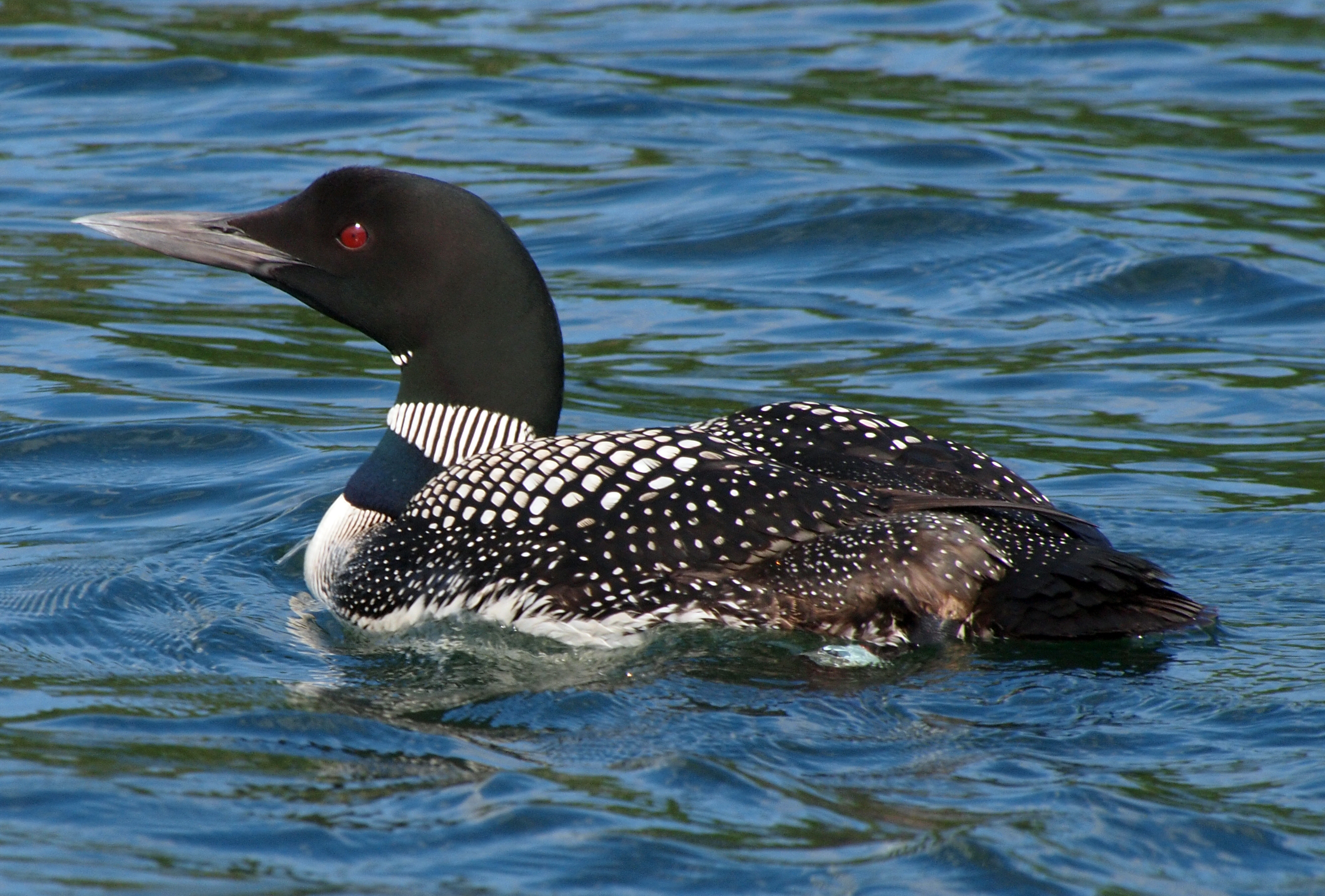
But beyond the man-made treasures are natures own. I say a double crested cormorant break the surface tension just a few yards from shore, its snaky head and skinny beak holding a recently speared fish. And of course the regal loons. Black and white and putzing about in the bay, fishing for lunch, and later in the evening their eerie cray bounces off the trees and islands. These are a few of perks a busker gets all in the course of a days work.

The Mount Visits Meredith
As a novice busker starting out, I use to take a music stand, song books, chairs, stools, and a hundred other assorted things I thought I needed. I found out fast that instead of helping, these extra things were an annoyance and  created a barrier between you and the folks you were entertaining,  Plus they were a pain the butt to schlep. Talk about a case of the droppsies. Whoops!!

The trick is to learn as many songs as you can without the books in front of you. And pray that parents with kids will walk by. Oh how I love the tykes. I do a chorus or two of "Puff the Magic Dragon" or, "Bingo Was His Name" and they stop, listen, respond with a shy smile and start dancing. When the parents give them money to drop in the bread jar, sometimes they actually hit the jar. Sometimes they don't and sometimes they take money out of the jar. Smart kid.

Loon. June. Honeymoon.
Look the people in the eyes when they walk past. Making eye contact in essential and smile all the while.
No one likes a crabby faced busker. Ask if they have a favorite song or singer and try to make them happy. Even if you don't know a song from their favorite, always say something like.."I don't but would this do?" and then play something that sounds like them. Recognition will bring you a buck or two.

To say I don't busk for money would be a lie. Of course I do, but frankly, observing the human condition and making people happy produces a feeling beyond avarice. As Don McLean says in "American Pie"...."and I thought if I had the chance that I could make those people dance and maybe they'd be happy for awhile."

Don't try to sing too loud. Use your regular voice unless its a real rocker like Hank's "Move It On Over", then, go for it. And don't get too fancy with your instrument unless you shred like Chet Atkins..

I love the lazy summer days on the Big Lake and all the joy and sunshine that comes with it. But when autumn comes, I feel rather sad. As Joanie Mitchell says in her song "I'd like to bring back summertime and let it stay a month or so. But I get the urge for going, and I never seem to go."

More on busking in another post.


Tuesday, August 23, 2016

Copland and Ives

Its been a while since I have written anything here, but life is what it is. Neither terrible or gorgeous. Just a lot of stuff between smiles and frowns.

I happened to have my Sirrius radio turned to the classical station earlier today as I was doing the semi-weekly dump run and suddenly I felt myself tumbling head first into a Currier and Ives print.
Not for the first time has this composers music transmorgified me.
Here I fell.

It swelled out of the radio; these throat catching melodies written by Aaron Copland as a soundtrack for the 1940 movie Our Town, based on the Thornton Wilder play of the same name.
Copland wrote for many Hollywood films, having been influenced by Bernard Herrman, and Eric Wolfgang Korngold among others.
He believed and said that movie music had to achieve a balance and should be ..."secondary in importance to the story being told on the screen" while notably adding to the dramatic and emotional content of the film-but without diverting the viewers attention from the action.
His scores include Steinbeck's Of Mice and Men (1939), The Red Pony (1949) and William Wyler's The Heiress also from 1949. (That was a terrific year for Copland with the release of two of his soundtracks and for which Heiress won the Academy Award for best score.)

But back to Currier and Ives.

I grew up in Wilmington, a small hamlet in Vermont, perhaps not much different then Grover's Corners in New Hampshire. It was a farming community with many dairy farms in the surrounding country side which dotted an emerald valley pierced by the Deerfield River.
Wilmington Vermont, looking southwest from Lilac Hill Road

I see the mother, in the place of her belonging, apron and hair tied back. A plain cotton dress. No makeup but only what the years have lovingly sculptured.Somehow, when I hear this music, I can smell the inside of a farm house. The stale air filled with clutches of wood smoke, dried paint from the kitchen, left over apple pies, many meals of salt pork, ham, beans and corn.

And there is a porch. Screened in, door banging early in the morning when the man and woman awake and the dog is let out. There is fog. Late summer. Early fall. Sound seemed more amplified back then.
Outside the farmhouse windows the stonewalls, marking the boundaries of the land, wander through meadows green, pastures dotted with bits of granite dropped carelessly by a passing glacier and orchards groaning with first fruits.

The old man coughs and hitches up his overalls but will not light his first pipe of the day until the cows have been milked watered and fed and he has time to step into the kitchen for a cup the blackest of black coffee
Randy Newman borrowed liberally from Copeland to slide his soundtrack into the movie The Natural.
But hey. If you're going to copy someone, copy from the best.

Copeland was born in 1900. His mother, Sarah Mittenthal Copland, sang and played the piano and arranged music lessons for her children. At the age of 11 he devised an opera scenario he called Zenatello which included seven bars of music, his first notated melody. He went to Paris in 1925 to study with Nadia Boulanger an extraordinarily gifted composer, conductor and teacher. Many Americans followed, including Quincy Jones, Daniel Barenboim, Philip Glass and Virgil Thompson among others who swam up in the rarefied atmosphere of genius.

He was a lover of jazz and much of his early work reflected this, such as Music for the Theater and his 1927
Piano Concerto.He would later in life write a Clarinet Concerto commissioned by The King of Swing himself, Benny Goodman. (Goodman also being a superb interpreter of classical music!)

But it was nationalistic leanings that caught the attention of a growing number who recognized his genius. He had a remarkable ability to capture the music of the people, their ballads, folk music and such and weave them into his compositions such as Rodeo, A Lincoln Portrait (which accompanied a written recitation.),  Fanfare for the Common Man (1940). It's interesting to note how this piece has bookmarked so many things. I remember watching a CBS TV show in the 1950's called Air Power, which the fanfare was featured as it's theme and later the Rolling Stones and Emerson Lake and Palmer tacked it to their performances. (Rolling Stones ?)

As he wrote with America in mind, he was becoming a populist (a phrase being battered around in politics these day ala' Trump) much like Vaughn Williams who drew on a well of English country songs or Smetana who did the same for Czechaslovakia.

But Copland went a little farther and used actual folk ballads, such as the Shaker hymn It's a Gift to be Simple from 1944's Appalachian Spring.
Movie poster from 1940


Listening to the music from Our Town, I can see the graveyard above the town. The kitchens, the church, the porches of this simple village. I can hear their ghosts and I smell the rich black earth and hear the rustle of the elms and birches, scattering their leaves upon the gray granite tomb stones and moss covered stone walls that wander through the green fields and, in vain, have tried to stop the encroaching woods.
 I feel so much, age, dust, bitter-sweet and time spinning away when I hear the horns and reeds washing over the strings. The sheer simplicity of Copland takes my breath away.

So, in essence, the music, it seems, can act as a memory booster, or, in my case it gave me a memory I never had. Prememorization. Hah! I just invented a word.

In Donald Grouts book, The History of Western Music (1960 W.W. Norton) he mentions that."....his (Copland's) material is subtly transfigured and its essence absorbed in a work that sincerely and simply expresses the pastoral spirit in authentically American terms." Of course the book doesn't mention that, as a gay man, (something that was toxic to mention back then) he allegedly had affairs with many prominent men of music, including Serge Koussevitsky and Leonard Bernstein.

But back to Our Town. The play and the movie followed the same structure, except for the ending. In the movie, (spoiler alert) one of the main characters, Emily, does not die.

Ah Hollywood. You gotta love it.

The play and movie have been thought of as "metatheatre". This word, coined by Lionel Able in 1963, has entered into common critical usage. Lionel Ables, a prominent Jewish playwright and critic was the first to use this phrase and it essentially means to  reflect comedy and tragedy, at the same time, where the audience can laugh at the protagonist while feeling empathetic simultaneously. Sort of like about every one of the last few years episodes of  M*A*S*H.

As for Wilder, (the guy who wrote Our Town - remember?) he wrote the play while in his 30s. In June 1937, he lived in the MacDowell Colony in Peterborough, New Hampshire, one of the many locations where he worked on it. During a visit to Zürich in September 1937, it is believed he drafted the entire third act in one day after a long evening walk in the rain with a friend, author Samuel Morris Steward.

Of course this has nothing to do with Copland, Newman or Currier and that other guy. But, what the heck. It is information.

Sunday, May 8, 2016

Serenade In Khaki and Yellow


What is it that makes a man think fondly of a regiment? A ship? A particular airplane or a military installation of any kind?

Is it nostalgia?

Nostalgia is a word derived from the Greek nostos; to “return home”.

Websters further defines nostalgia as homesickness or an “excessive yearning…. to return to a past experience….. or irrecoverable condition.”  I like that idea. An “irrecoverable condition.”
 
Crossed sabres and a youthful fools image
I will never be that young man of seventeen again who, over fifty years ago found himself with a group of men, similarly stunned and groggy at five AM in Fort Dix NJ jarred from an exhausting sleep by a bugle. Revile resounded through the speakers in and around that base that had seen so many sons, husbands, brothers and fathers plunged into the world of salutes, orders, work and  weapons that followed the drumbeats of war.

Reveille. Played around sunrise and signaling the first formation of the day remains to me a call at once nostalgic and slightly annoying. It interrupted many a pleasant dream and began many a self-inflicted hangover.

But it was a plank in the structure of living I needed at that time of my life.

And throughout the day bugle calls would mark the clock – mess call, mail call, taps and everything in between. I cannot hear any of these calls today without smiling at my youth as it flew by and I sat looking out the window,  having no idea of where I was bound.
The patch known affectionetly
as "The Horse Blanket"

My regiment, the regiment that I remember and look back on with a sense of pride was the Seventh Cavalry of the First Cavalry Division.

 “Gary Owen, sir!” was the cry from your mouth once you donned the yellow scarf, sewed on the “Horse blanket” shield with horses head on your sleeve and wore the crossed swords with the number seven in the crossed blades. And the pin on your cap or jacket with the hand holding the sword rampant and under a horse shoe with the words “Gary Owen” scrolled over the top was a badge to treasure, for within it rolled a list of men who had laid down their lives for these latter day horse-soldiers, including this geeky journalist-without-a-clue.

I am proud of that regiment. It was a home for me and a school of life, teaching me discipline, courtesy, responsibility and respect for all those men who had gone before. As an imbedded correspondent with the regiment, I had time to research.

Ia Drang Valley. Vietnam. New steeds
for the Cavalry
Garry Owen, from the word garryowen is derived from Irish. The term refers to the area of Garryowen in the city of Limerick, Ireland.
This song emerged in the late 18th century, when it was a drinking song of rich young fops in Limerick. It obtained immediate popularity in the British Army through the 5th Royal Irish Lancers.

Believe it or not, Ludwig Beethoven himself composed two arrangements of the song  in 1809–1810.

In early 1851 Irish citizens of New York City formed a militia regiment known locally as the Second Regiment of Irish Volunteers. The group selected "Garryowen" as their official regimental marching song.

It later became the marching tune for the American 7th Cavalry Regiment during the late 19th century.
The tune was brought to the 7th Cavalry by Brevet Colonel Myles W. Keogh and other officers with ties to the Fifth Royal Irish Lancers and the Papal Guard, two Irish regiments in the British Army. As the story goes, it was the last song played for Custer's men as they left General Terry's column at the Powder River.

The name of the tune has become a part of the regiment; the words Garry Owen are part of the regimental crest.

There is a Camp Gary Owen north of Seoul, Korea, (my old stomping grounds) which houses part of the 4th Squadron of the regiment. There is also a currently operating Forward Operating Base, FOB Garryowen, within the Maysan province of Iraq. FOB Garryowen was established in support of Operation Iraqu Freedom 8–10 in June 2008 by 2nd Battalion, 7th Cavalry Regiment. 

Operation Iraqi Freedom. 2003
The 7th Cavalry became a part of the 1st Cavalry Division in 1921, and "Garryowen" became the official tune of the division in 1981.

The tune became the name for bases established by the Cavalry in current conflicts. The most recent was Combat Operating Base, (COB), Garry Owen in the Maysan Province of Iraq.

But I also see a crushed brim hat, fierce mustachioed John Wayne and the awesomeness of the Monument Valley so dear to John Ford. “The Cavalry Trilogy”(She Wore a Yellow Ribbon, Rio Grande and Fort Apache) it was called; those movies with a brass band background and a filmed realness so well done that you could almost smell the sweating horses, men, manure and dust kicked up by tons of flesh rolling as one in a charge with the flags, guideons and company banners flapping gamely.

That’s when I sit up…on the edge of my seat and remember that time so long ago in the back of a deuce and a half in Korea. Bugging out on a cold morning. Knowing the North Koreans had moved their tanks across the DMZ. Clutching my M1 (I still remember the serial number) and jiggling with freshly issued live ammunition. And I wore a crushed khaki cap with a crossed sword seven pinned to the front, totally out of uniform and grinning like a fool. I was further armed with a 70 mm signal corp issued combat camera lay snug beside me. I figured I could club a “gook” with it if he got too close.

Yeah George. Brilliant!!! You young fool.

And all the old guys cramped on wooden benches and sitting around me  Guys who’s memories of 2nd WW and a bullet riddled Korea made up their resume. They all shook their heads and laughed at me. They knew. 
I didn’t.

All I could see was John Wayne and all I could hear in my head was an Irish drinking song. Where was Drop Kick Murphy when I needed them?
Not even born yet.


Wednesday, October 15, 2014

The Worm Steamed Into A New Junction

I appreciate all the fans and comments I have received at this blog spot. But things change, the locomotive went into the roundhouse for a tuneup and reemerged with a new livery and a new station.
The Earworm in person.

From now on if you want to check on the music of the Great American Popular Songbook just switch tracks and head into http://earwormjunction.com/  for more good music and comments. I may sneak back here every now and then....but till then......adieu!!

Thursday, September 25, 2014

I Wonder Who's Kissing Her Now

The Earworm was feeling better this morning and I awoke with a couple of songs ringing in my head, among them what I thought to be an Irving Berlin classic. But I was a bit off the mark.

"I Wonder Who's Kissing Her Now" was a very popular tune published in 1909 and written by Joseph E. Howard and Harold Orlob will lyrics by Will M. Hough and Frank R. Adams. So much for Irving.

I think I came to the erroneous conclusion of its authorship because it sort of sounds like something he would write. Pleasing lyrics. 3/4 time. Very beautiful melody that will curl around your cerebellum and nest there for a while. If my pal to, whom I assured that this was a Berlin number, is reading this - my humblest apologies.

Joe Howard, born February 12, 1878 in New York City is the first Tin Pan Alley fixture turned up by The Worm who was not born in Eastern Europe. He wrote music with a lot of folks, probably his best collaboration was with his wife composer Ida Emerson with whom he had many hits including "Hello Ma Baby", part of Michigan Frogs repertoire from that classic Warner Brothers/Chuck Jones cartoon "One Froggy Evening."

Michigan as himself!
You remember. The one where the guy gets a singing, dancing frog out of a tin box he found while demolishing a building and ends up losing his money, his home, his job and his mind when Michigan would only perform for him. And no one else.

It contained several classic songs from the American Songbook including "I'm Just Wild About Harry", and a song written for the cartoon, "The Michigan Rag" from whence the frog got his moniker.  Steven Spielberg in Jones's PBS biography called "One Froggy Evening, released in 1955, the "Citizen Kane" of animated films. High praise indeed.

But getting back to the song. "I Wonder Who's Kissing Her Now" was introduced in the Broadway show entitled, " The Prince of Tonight" which fell into oblivion leaving only this tune. I find it lovely...somewhat sad and melancholy. Maybe that's the reason I felt it "Berlin-ish" because of the mood invoked by a song he did write about the same time called, "What'll I Do?" which also laments love lost.

Very seldom is the verses sung, usually just the chorus, which shortens it somewhat.

The verses, or the intro, is a little less melancholy as the narrator berates a young man for leaving one girl behind to romance another and a suggestion that she may be doing the same thing he is. And the rhythm is a little faster then I like.

I like?  I like Harry Nilssons' version of the song from his "A Little Touch of Schmilsson in the Night" album released in 1973 years before doing standards would ever become popular, but it is considered a fine example of Nilssons' virtuoso chops. Harry was charming to listen to. He had a voice. The album title is a play on Shakespeare's Henry V Act 4 where the chorus referrers to Henrys visit to his troop as a "little touch of Harry in the Night." I never knew that.

Nilsson left us too soon. He died of a heart attack in January of 1994, a little over 20 years ago.

I never quite figured out Harry. I mean he wrote such good songs, "One" or "Coconut" ("You put the lime in the coconut and drink it all up!"....I always see Muppet's when I hear that song) or "Without You" and he sang "Everybody's Talkin' Bout Me"  for which he received a Grammy in 1970,  from the movie "Midnight Cowboy". It was written by Fred Neil, however. Not by Harry.

He never exploded all over like everyone said he would. They said he was a new Beatle.

He had a modicum of commercial success in the 1970's in spite of the fact her seldom ever gave concerts or went on any tours. Maybe that was the reasons he never really took off. He recorded a lot. He mode a tv cartoon, "The Point" in which he wrote all the songs. Remember "Me and My Arrow"? He was an odd duck who had close friends ranging from Mickey Dolenz of "Monkee" fame, Paul McCartney and John Lennon who he was very close to and went on occasional drinking binged with. He was deeply shaken by Lennon's assassination and was a strong advocate for gun control after his death.

I love his voice and who knows what wonderful things he would have produced if he had a lived a bit longer.

So long till tomorrow.


Wednesday, September 24, 2014

Steve Goodman - In Memorium

The Earworm wasn't feeling well this morning so I gave him the day off and will concentrate instead on one of the best singer-songwriters this country has ever produced.

Steve Goodwin passed away around this time of year thirty years ago, dying of kidney and liver failure as a result of leukemia in Seattle Wash. on September 20, 1984. I didn't realize it had been that long.

I first heard of Steve probably around the same time you did with the release of the Arlo Guthrie hit "City of New Orleans" which Goodman penned while campaigning for Edmund Muskie in the 1970's.

Guthrie tells the story that, after he had finished a  late night gig in New York, he was asked by his friend to listen to "this young dude who's been pestering me." Arlo saw this little guy out of the corner of his eye with a guitar in his hand. He thought..."Oh no! Not now. I'm really beat. Some other time." But Steve was persistent and Woody's boy finally said..."Ok. Buy me a beer and as long as I'm drinking the beer you can do what ever you want." Steve bought the beer. Arlo listened and a while later he recorded what would become for Goodman a song that, as he later said...."Saved my ass!"

My brother gave me a couple of his vinyls in the mid 80's ("Artistic Hair" and "Santa Ana Winds" which were both pressed on his own label, Red Pajamas) and told me to listen to this guy. I would like him. I did and I do.

He plays a mean guitar and has a very self depreciating style of delivery with a pleasant voice that never bores you. And prolific? Well I guess.

Steve discovered he had leukemia around the summer of 1967 while attending Lake Forest College in his home town of Chicago where he was born into a middle class Jewish family on July 25, 1948 and decided to spend the rest of what life left him; focusing on songwriting and performing which he had been doing since before 1964.

Despite critical acclaim, Goodmans recording never sold particularly well (Bob Dylan even played piano as Robert Milkwood Thomas on "Someone Others Troubles.") and by 1973 he was still living in a $145-a-month apartment just a few blocks from where his beloved Chicago Cubs blundered into obscurity every fall. "The doormat of the National League...." he would pen in his classic song, "A Dying Cub Fans Last Request" which I had a chance along with another gentleman to perform in my brother Garys show, "Play Ball" which hit the boards in the Players Ring in Portsmouth a few years ago. It's a great song and, just a few days after his death in 1984, The Cubs clinched first place in the National League East for the first time since 1945. And a song he wrote called "Go Cubs Go" is still played today when the Cubbies win. "Hey Ernie. Let's play two."
Steve wearing his beloved Cubs hat.

Then came "City of New Orleans" and a firm foundation for Steve to stand on and go forward.

I love his songs. They are warm, uncomplicated and speak deeply of our fears, our hopes and dreams along with gentle humor. Even when things go wrong. Which happen to all of us occasionally. His rendition of "My Old Man" brings tears to my eyes, but, on the Youtube clip, his guitar strap slips off his guitar before he sings, (Tell me about it!) and in a live album, "Artistic Hair" when he sings a holiday standard, "Walking in a Winter Wonderland" he forgets the words at one point but easily covers it by singing....."It's really absurd. When you don't know the words. To "Walking in a Winter Wonderland." Beautiful!

Please find and play some of Steve Goodman's stuff. I recommend "Affordable Art", "Santa Ana Winds" and "No Big Surprise: The Steve Goodman Anthology".  there are also many artist's besides Arlo who have covered him including John Prine, John Denver, David Allan Coe and Joan Baez.

Hopefully the Earworm will be feeling better tomorrow.

Adios!